Commercial Switchboard Repairs
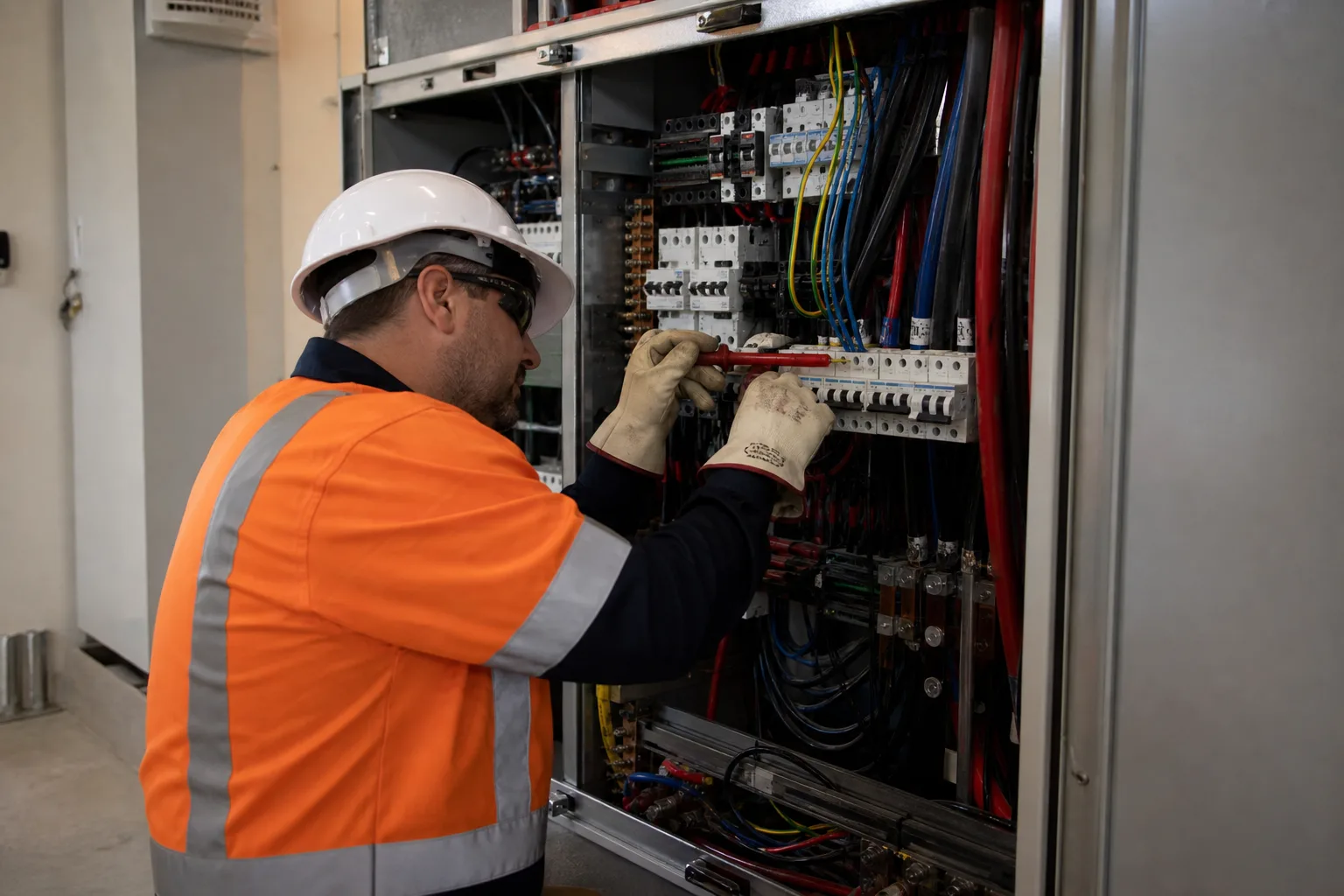
Commercial switchboard repairs involve finding and safely correcting faults in the board that distributes power through your business premises. A licensed electrician checks the affected circuits, protective devices, wiring and enclosure, then completes the necessary repair and testing. Camma Electrical helps Melbourne businesses deal with damaged, unreliable or overloaded switchboards properly.
5.0★
Local rating
REC 36165
Licensed electrician
Fast
Local response
$20M
Public liability
What Does A Commercial Switchboard Repair Involve?
Commercial switchboard repairs restore the safe control and distribution of electricity to a business premises.
Your switchboard is where incoming power is divided into circuits for lighting, power points, equipment, air conditioning, kitchen appliances and other parts of the site. When something inside it fails, the problem may affect one circuit or take out a larger part of the premises.
A repair is not simply replacing the breaker that has tripped. The important part is working out why it tripped, overheated, failed to reset or caused a loss of power before fitting a suitable replacement.
Finding The Actual Fault
A licensed electrician starts by identifying what is affected and when the problem occurs. That may involve checking the main switch, circuit breakers, safety switches, connections, cable condition and the load connected to the circuit.
A breaker that will not stay on can point to a faulty appliance, damaged wiring, moisture, an overloaded circuit or a problem within the board itself. Repeatedly turning it back on without finding the cause can make the situation worse.
Repairing And Testing The Board
Once the fault is located, the repair may involve replacing a damaged protective device, correcting a loose or heat-damaged connection, repairing wiring, replacing an enclosure component or separating an overloaded circuit.
The repaired circuit needs testing before it is returned to use. This confirms the protection operates as intended and helps avoid leaving a business with a board that appears to work but has an unresolved fault.
Signs Your Business Needs Switchboard Repairs
A commercial switchboard needs prompt attention when it shows heat damage, repeated tripping, burning smells, physical damage or unreliable power.
Do not ignore a board because power returns after a breaker is reset. Intermittent electrical faults can be difficult to pin down, and the timing of the fault is useful information for the electrician.
Problems You Can See Or Smell
Scorch marks, melted plastic, rust, water staining, damaged covers, buzzing noises or a burning smell all warrant a licensed electrician. Keep people away from the board if there is visible damage or signs of overheating.
A switchboard door, panel or cover is there to prevent accidental contact with live parts. Do not remove covers or attempt to tighten connections yourself.
- A circuit breaker feels unusually hot
- A safety switch or breaker will not reset
- Lights flicker when equipment starts
- Power cuts out in one work area
- There is water near the switchboard
- Labels are missing, unclear or no longer match the circuits
Problems That Affect Daily Operations
A fault can show up as a single power point circuit dropping out, a cool room circuit refusing to run, lights failing in one area or machinery stopping when another item is switched on. These details help narrow down the fault.
If equipment is essential to your operations, switch it off if it is safe to do so and arrange an electrician. Avoid moving high-load equipment from circuit to circuit as a workaround, because that can overload another part of the installation.
Why Commercial Switchboard Faults Need Proper Diagnosis
Commercial switchboard faults should be diagnosed before parts are replaced because the visible failure is not always the underlying cause.
A failed breaker may be doing its job by disconnecting a dangerous fault. Replacing it without checking the circuit, the connected equipment and the condition of the board can leave the original problem in place.
Overloads And Faults Are Different Problems
An overload happens when a circuit is asked to supply more current than it is designed to carry. A fault can involve damaged insulation, a failed appliance, moisture, a loose connection or an issue between conductors.
The repair depends on which problem is present. An overloaded office circuit may need its loads reviewed or additional circuit capacity considered, while a damaged cable or faulty appliance needs a different response.
Heat Damage Needs A Wider Check
Heat damage around a breaker or cable connection can affect nearby components as well as the visibly damaged part. The electrician checks the surrounding terminals, insulation, enclosure and protective devices before deciding the scope of repair.
Temporary fixes can create a false sense of security. A practical repair should address the cause of the heat, not merely cover up the evidence.
What Happens When A Switchboard Trips At Work?
When a switchboard trips at work, safely isolate affected equipment and have a licensed electrician identify why the protective device operated.
A circuit breaker or safety switch operates to disconnect power when it detects a condition it is designed to respond to. It is not a fault finding tool for staff to keep resetting during a busy shift.
The Monday-Morning Workshop Fault
For example, a small workshop opens on Monday and the circuit feeding several benches trips when the compressor starts. Staff reset the breaker, but it trips again as soon as the compressor is used.
The electrician checks the compressor, the circuit load, the cable and the switchboard connection. If the compressor is faulty, fitting a bigger breaker would not be a safe repair. If the circuit has been overloaded by added equipment, the right solution may involve repairing damage and planning suitable circuit capacity.
Information That Helps The Electrician
Make a note of what stopped working, what had just been switched on, whether the fault happens at a particular time and whether rain, cleaning or building works occurred nearby. This can save time when diagnosing an intermittent issue.
Only provide information you can gather without opening the board or touching damaged equipment. If there is smoke, sparking or a strong burning smell, keep clear and seek urgent electrical assistance.
Commercial Switchboard Repairs Or A Full Upgrade?
A commercial switchboard repair fixes a specific fault, while an upgrade is considered when the board is damaged, outdated or no longer suits the business load.
Not every faulty breaker means the whole switchboard needs replacing. Equally, a repair may reveal that the enclosure, protection, wiring space or circuit arrangement needs more substantial work.
When A Repair May Be Enough
A targeted repair may be appropriate where the board is otherwise in sound condition and the fault is limited to a defined component, connection or circuit. The electrician can explain what failed, what was repaired and whether any follow-up work is worth considering.
Clear circuit identification matters after any repair. Staff should be able to identify which circuits serve key equipment without guessing.
When An Upgrade Should Be Discussed
An upgrade conversation is sensible when a business has added machinery, heating and cooling, commercial kitchen equipment, server equipment, electric vehicle charging or other significant electrical loads. It can also be necessary where the board has widespread deterioration or no practical room for safe alterations.
The decision should follow an inspection, not a blanket sales pitch. A licensed electrician can set out the condition of the existing board and the options for the premises.
Commercial Switchboard Safety And Compliance
Commercial switchboard work must be completed by a licensed electrician and assessed against the requirements that apply to the installation.
AS/NZS 3000:2018, commonly called the Wiring Rules, is the primary standard for switchboard work in Australia. The standard covers electrical installation safety, and switchboard repairs need to account for the condition of the complete installation rather than one isolated component.
Metroid Electrical Engineering’s guide to AS/NZS 3000:2018 says switchboards need a minimum 600mm clear space in front when any part of the door is open, and 1.0 metre when all doors are closed.
JDN Contracting and Electrical Services says Clause 2.5.2 mandates a minimum 150mm working-space clearance between live parts and enclosure walls.
Safe Access To The Board
A business should keep the area around its switchboard reasonably clear, dry and accessible for authorised electrical work. Storage, shelving and stock placed tightly against a board can delay inspection and make safe access more difficult.
The switchboard should not become a noticeboard, storage cupboard or place for staff to hang tools. Covers and doors should remain in place unless a licensed electrician is working on the installation.
Why Licensed Electrical Work Matters
Safe Work Australia data shows serious workers' compensation claims for electricians due to electrocution are approximately six times greater than the all-occupations average. Electrical work around switchboards involves serious risks, including contact with live parts and faults that are not visible from outside the enclosure.
Camma Electrical is run by a working licensed electrician, REC 36165. We handle commercial switchboard repair work with the testing, care and documentation appropriate to the job.
How To Reduce Repeat Switchboard Problems
The best way to reduce repeat switchboard problems is to address the cause of a fault and keep the board suitable for the way your business now operates.
Businesses change over time. New equipment, extra staff workstations, altered tenancy layouts and changed operating hours can all increase demand on circuits that were originally installed for a different setup.
Commercial switchboards should be inspected by a licensed electrician every five years.
Keep Circuits Clearly Identified
Accurate labels help staff isolate the right circuit in a problem and help electricians work efficiently during maintenance or repairs. If labels no longer match the tenancy layout, ask for this to be reviewed during electrical work.
A clear directory is particularly useful where the board supplies several areas, tenancies, appliances or business-critical systems. It reduces guesswork when power needs to be safely isolated.
Plan Before Adding More Electrical Load
Talk to a licensed electrician before adding equipment that will run regularly or draw significant power. This gives you a chance to check whether the existing circuits and switchboard capacity are appropriate before installation day.
Planning is especially helpful for fit-outs, additional workstations, new air conditioning, kitchen changes, machinery and charging equipment. It is easier to provide suitable electrical supply as part of the change than after nuisance tripping begins.
What Happens When You Contact Us For Commercial Switchboard Repairs?
When you get in touch about a commercial switchboard repair, we arrange for a licensed electrician to assess the fault and explain the practical next step.
Tell us what is happening, which parts of the premises have lost power, whether anything smells hot or looks damaged, and what equipment was operating when the issue began. If the business has restricted access times or needs work coordinated around trading, mention that as well.
At The Site Visit
The electrician will inspect the switchboard and affected circuits, ask about the fault history and carry out appropriate testing. You will get a plain explanation of what has been found and whether the issue can be repaired directly or needs further work.
If isolation is needed for safety or testing, this will be discussed with you where practical. The aim is to make an informed decision without guessing at the cause.
After The Repair
Once the repair is complete, the relevant work is tested and the affected circuits are checked before being returned to service. If the inspection identifies other concerns, they will be explained clearly so you can decide what to address next.
For commercial switchboard repairs in Melbourne's south-east, get in touch with Camma Electrical. You will be dealing with a licensed electrician who can assess the problem properly.
CLIENT REVIEWS
WHAT CLIENTS SAY
20 reviews on Google →
Common Questions
How much do commercial switchboard repairs cost?
Commercial switchboard repair costs depend on the fault, the equipment involved, access to the board and whether replacement parts or wider repairs are needed. A simple damaged component is different from heat damage affecting multiple connections or a fault in the circuit wiring. An inspection is the sensible way to establish the work required before pricing it.
How long does a commercial switchboard repair take?
The time required depends on what caused the fault and whether it can be safely isolated and repaired on the first visit. Some issues are contained within the switchboard, while others require fault finding along the circuit or checking connected equipment. The electrician can give you a clearer timeframe after inspecting and testing the affected installation.
Can I keep resetting a circuit breaker at my business?
No, repeatedly resetting a circuit breaker is not a safe solution when it keeps tripping. The breaker may be responding to an overload, faulty equipment, damaged wiring or another electrical issue. Leave the circuit off if it will not remain on, avoid using affected equipment, and arrange for a licensed electrician to investigate the cause.
Does a tripped safety switch mean the switchboard is faulty?
Not necessarily, because a tripped safety switch can be caused by a fault in the circuit or equipment connected to it. Moisture, damaged leads, appliances and wiring faults can all be involved. A licensed electrician needs to test the installation to determine whether the problem is in the switchboard, the circuit or a connected item.
Is it worth repairing an old commercial switchboard?
It can be worth repairing an old commercial switchboard if the fault is limited and the board remains suitable for the premises. If it has widespread damage, poor circuit arrangement, inadequate capacity or repeated faults, an upgrade may be the better long-term option. An electrician can assess the condition and explain both options without assuming replacement is necessary.
Sources
- Metroid Electrical Engineering — AS/NZS 3000:2018 sets out clearance and access requirements for switchboards, including electrical rooms.
- Metroid Electrical Engineering — AS/NZS 3000:2018 requires at least 600mm clear space in front of a switchboard when any door is open, and 1.0 metre when all doors are closed.
- JDN Contracting and Electrical Services — AS/NZS 3000:2018 requires a minimum 150mm working-space clearance between live parts and enclosure walls.
- Roshaaco — Commercial switchboards should be inspected by a licensed electrician every five years.
Need a commercial switchboard fault checked properly? Get in touch with Camma Electrical.
Get a free, no-obligation quote from your local licensed electrician.